
The Complexity Trap: A Modern Update to Maslow's Hammer
Whether you are building a data platform or packing for a weekend trip, our obsession with expertise is causing us to over engineer reality.

In 1966, psychologist Abraham Maslow made a brilliantly cynical observation about human behavior. He wrote, “I suppose it is tempting, if the only tool you have is a hammer, to treat everything as if it were a nail.”
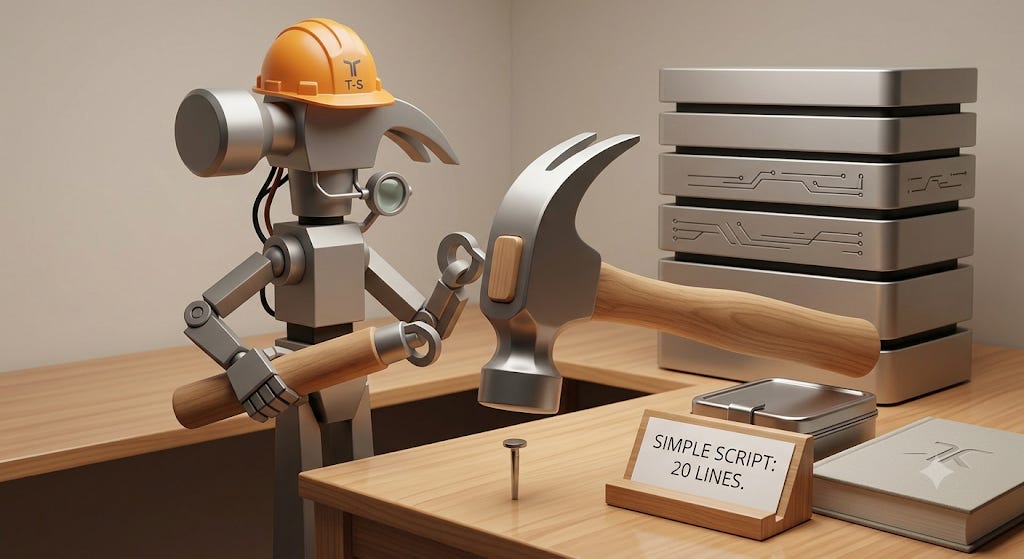
Maslow was talking about cognitive biases, but if you spend your days working in tech, you eventually realize this psychological quirk is the foundational architecture of the modern world. We like to believe that when we are handed a new problem we evaluate it in a vacuum of pure, objective logic. We picture ourselves as rational architects, patiently surveying a pristine plot of land before deciding on the best possible blueprint.
We do not.
The moment we look at a problem, our brains instantly warp its dimensions until it perfectly fits the shape of whatever skills we spent the last five years mastering. We are prisoners to our own expertise, deeply comforted by the tools that make us feel competent.
The T-Shaped Learning Trap
In the corporate world, there is a heavy emphasis on becoming a T-Shaped individual. You are supposed to have a broad, shallow understanding of many concepts (the horizontal bar), but possess a deep, highly specialized expertise in one specific area (the vertical stem).
In theory, this makes you a versatile, valuable asset. In reality, that deep vertical stem acts like a supermassive black hole. Its pull is so strong that no simple solution can ever escape its event horizon.
When you spend your life deep in the world of software engineering, mastering distributed cloud architectures and pushing the boundaries of AI, that knowledge becomes your default lens for reality. You don’t just have a Golden Hammer; you have a fully automated, horizontally scaling, cloud-native Golden Piledriver. And suddenly, every single minor request looks like a bedrock foundation that desperately needs smashing.
If a product team asks for a simple daily list of 500 new user signups, a junior developer will write a 20-line Python script, set a cron job, and go to lunch. But a seasoned data platform engineer? Their internal defense mechanisms trigger immediately.
“500 users? But what if we get a million users tomorrow? What if the API goes down? We need fault tolerance! We need observability!”
The 20-line script is immediately murdered. In its place rises a multi-node Kubernetes cluster. The data is suddenly being streamed in real-time through event brokers and monitored by custom dashboards. The engineer didn’t build a solution for the product; they built a security blanket for their own existential dread.
The AI Relevance Panic
In recent years, this psychological trap has been flooded with gasoline, courtesy of the generative AI boom.
As artificial intelligence models become increasingly capable of writing that 20-line Python script in about four seconds, the baseline tasks that used to make up a developer’s day are vanishing. The horizontal bar of our T-shaped knowledge is being rapidly commoditized.
So, how do human experts respond? We retreat to the vertical stem. We subconsciously build labyrinths that AI cannot easily navigate.
There is a growing, unspoken trend across the tech industry where engineers are intentionally sticking to impossibly complex systems just to stay relevant. If a problem is solved with a simple script, an AI agent could likely maintain it. But if the problem is solved using a convoluted, hyper specific, multi layered microservices architecture that requires a Ph.D. in YAML to decipher? Well, you absolutely need a highly paid human to keep that afloat.
We hallucinate scale and demand complexity because it serves as a protective moat around our careers. If the system is impossible for anyone else to understand, we are impossible to fire.
The Crushing Cost of “Just in Case”
The risk of this behavior, of course, is catastrophic technical and operational debt.
When we let Maslow’s Hammer dictate our architecture, we build massive Rube Goldberg machines (here is a fun-read on what Rube Goldberg machines are) just to pour a glass of water. Startups burn precious runway paying for enterprise grade cloud infrastructure they don’t need. Engineering teams spend 80% of their sprint cycles maintaining the pipeline instead of actually delivering the product.
By over engineering for a hypothetical future that may never arrive, we paralyze ourselves in the present. We confuse motion with progress, and complexity with sophistication.
The Hallucination of Scale
Just as a Large Language Model will confidently hallucinate a fake historical event rather than admit its internal database is coming up empty, a specialized human will hallucinate complexity to justify their own expertise.
And this is where Maslow’s Hammer escapes the server room and infects everyday life. We all do this, regardless of our profession. We weaponize our expertise to overcomplicate the mundane because a simple solution feels entirely too vulnerable.
The Culinary Hammer: Ask a Michelin trained chef to make a grilled cheese sandwich, and they physically cannot just put American cheese on white bread. They will hallucinate complexity. They will source 12-month aged Gruyère, culture their own butter, and utilize a blowtorch.
The Design Hammer: Give an aesthetically minded homeowner a simple task like refreshing a bedroom. They can’t just put up a poster. The hammer swings, and suddenly it demands a royal aesthetic. The room didn’t need museum grade curation, but the homeowner’s eye for design demanded a canvas.
We force fit massive, rigorous frameworks onto lightweight problems because if the problem only requires a basic, low-effort response, what did we spend all those years getting certified for? What did we spend all those hours researching and agonizing over? We inject complexity into our projects and our lives because complexity feels like validation. It proves we are the Adults in the room, fully in control of our sophisticated domains.
The Beautiful Art of Doing Nothing
The great, unspoken truth of adulthood is that we are all terrified of being exposed as unnecessary. If our hard earned skills aren’t actively required to keep the sky from falling, we don’t quite know who we are.
But true maturity, whether you are writing code, designing a bedroom, or making a sandwich, isn’t about deploying the heaviest framework you know. It is about having the quiet confidence to look at your beautifully complex, T-shaped expertise, acknowledge how incredibly powerful it is, and then intentionally leave it in the toolbox.
It is the realization that a master carpenter doesn’t use a sledgehammer to hang a picture frame.
Sometimes, the universe doesn’t need a quantum leap. Sometimes, it doesn’t need a cutting edge AI integration or a flawless, scalable architecture. Sometimes, it just needs you to accept the simplest answer, write the 20 lines of code, and go eat your lunch.